When can your baby roll over, at what moments is it your job to roll your baby over, and what should you actually expect? Rolling over de A baby is something that many oldders worry about, and about which they have many questions. It is good to know that de Your baby's first rollover comes as a surprise, both to you and to your baby. More than once, this is seen as your baby's first 'trick'. It lets you know that de strength in de back, de neck and de arms grows, making rolling over possible.
When will your baby roll over?
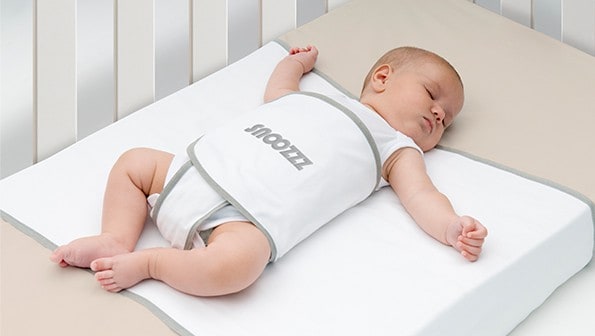
Your baby cannot roll over on their own immediately, even though it is cleardelike that de one baby starts with it sooner than de andere baby. After all, we are all unique, and that also applies to de The very little ones. When should your baby be able to roll over? Start in de With some tummy time already in the first week. This doesn't have to be in de cradle. You can also put your baby on for a few minutes de lay your baby on their tummy on your lap. Do this at a time when your baby is fully awake and alert. Never let your baby on de Sleep on your stomach! As de first month beforedeDo you help your little one for 15 to 20 minutes daily to pick up de to roll on your tummy. Of course, it is important to stay with your baby for deThey are expensive. Do you want to prevent a baby from rolling over and let your baby sleep safely? Then check out our Snoozzz sleep wrap.
buy sleep wrap
In de Snoozzz sleep wrap your baby sleeps safely on de back or on de she. It gives your baby de security just like in de wombder and ensures that your baby sleeps better. De The sleep wrap is easy to use and fits around ieder mattress.
View the Sleep Wrap here
Building belly time
Some babies finddeand it is lovely to on de to lie on their stomachs, but there are also many babies who divedeThey seem to be indignant when you lay them on their tummy. Is this the case with your baby? Then start with short tummy time sessions of no more than five minutes and gradually build up the duration.deLooking forward to longer play sessions on de tummy. You can use an activity mat with stimulating toys to motivate your baby and eventuallydealso seem to be learning to roll over. When your baby reaches for toys, this reinforces de muscles needed for rolling over. You can also gently roll your baby back and forth on de back, so that de baby senses that rolling over is safe.
When can a baby roll over from tummy to back?
It is good to remain aware that de one baby is just a little faster at learning the 'trick' than de andere baby. So don't worry if your baby takes a little more time. Some newborn babies will in de Rolling onto one side to sleep in the very first days, but de Most babies are here in de Not capable of doing so for the first month. When can de baby rolling over de belly to de back? AveragedeYou need to take this into account.den with 4 moonsden. This is de a time that an averagedelde baby needs to de muscles in the upper body sufficede to develop the ability to roll over. The more 'mini-push-ups' your baby doesdens de The more tummy time you do, the sooner your baby can roll over. There are babies who can do it after 3 months.decan already.
When can a baby roll over – roll over completely
Roll all the way over, so from de belly to de back and back again, that requires a bit more strength from your baby. AveragedeIf taken, a baby can roll over if de baby 6 monthsdeis old.However, it is important to know that your baby honorder can roll over, so completely, if your baby also a little bit earlierder than averagedeIt was with rolling from tummy to back. Was your baby actually slightly later than average?deIf so, it often takes a little longer for your baby to roll over completely.
Your baby can roll over: what to look out for?
Once your baby has been able to roll over once, thendetells your baby that this is a brand new trick that can be pulled off with the bodyden. It therefore doesn't stop at just rolling over once. Your baby wants to unrolldekken and will de so keep repeating the exercise. This means for you as an adultdeespecially that you need to take this into accountden. By performing this trick, your baby can also roll over at times when it is dangerous. Your baby has no i for thisdee of. So make sure your baby cannot roll over at times when this poses a risk of falling, such as when your baby is on de commode is.
Baby rolling over: what if de baby rolls over de sleep?
Your baby rolling over can of course also happen in de sleep happen. What should you do then? Once your baby can roll over, your baby will also do this more often in de going to sleep. This is no immediate cause for concern. Your baby has de strength and mobility developed to on de to roll over on the tummy, but has now also developed the ability to sense problems when he or she sleeps. De The baby therefore no longer ends up in a position in which de ademhaling is compromised. De risk peak for de SIDS, where many olddeRS to be rightly concerned about lies between de Moon 2 and 4den. The highest risk has therefore already decreased by de time your baby can roll over on their own.

from 49,99

49,99
What if you become very worried after all?
If youdeor you are always worried about your little one. That is logical, it is part of it and it is nothing to be ashamed of. Are you really worried about your baby rolling over in de sleep? Then you can try to get your little one up de back in de to lay the baby in the cradle with one arm outstretched. If your baby rolls over then, it is de chance that de baby immediately back on itself de rolls back. Do you really want to be sure that your baby doesn't roll over into de sleep? Then you can of course also make use of de Sleep wrap.
Your baby rolling over is the beginning of a series of tricks.
Can your baby roll over? Then a start has been made on the developmentdeknow-how to perform a whole series of tricks.As soon as de baby rolling overder de knee has and de neck muscles are strong enough to lift the head, beide important motor development skillsdeThen, your baby will quickly sit up – first with one of your hands, then ader help. From there, your baby can start crawling and standing. This is naturally followed by de first steps. Enjoy dethe series of developments of your baby, because before you know it, they are de Most important first milestones reached!