


Baby's sleep rhythm: a different sleep rhythm every month
Baby's sleep pattern? A mystery for parents! Your baby's sleep pattern can be hard to follow. One moment your baby wakes up at 8 o'clock, the next week that has suddenly adjusted to 6 in the morning. The reverse happens too, of course. Your baby sleeping through the night might go well for a week, and then suddenly your baby wants to be fed twice a night again. One night your baby might sleep through, the next night their sleep pattern seems completely turned upside down and they wake you up three times a night. Reason to worry? No, certainly not! Your baby needs time to develop a good sleep pattern.
When does a baby sleep through the night?
Many parents ask themselves after just the first week or two: when will my baby finally sleep through the night? It makes sense! Those interrupted nights are exhausting. Your baby doesn't want to sleep through the night, so you, as a parent, don't get the chance to sleep either. Unfortunately, getting your baby to sleep through the night isn't a matter of doing certain things and not doing others. Your baby isn't sleeping through the night because they are still in the process of developing a sleep rhythm. This simply happens faster for some babies than for others. It is important to support the development of a sleep rhythm as much as possible. In this regard, it is of course also important to know what is 'normal' for a baby. By 'normal,' in this case, we mean the average sleep rhythm of babies.
Buy a baby mattress
The core of the Snoozzz Comfort baby mattress is made of the best quality cold foam with high resilience, which is important for the proper development of the spine.
View the baby mattress here
Newborn baby doesn't want to sleep in crib
Many parents also have to deal with this: their newborn baby doesn't want to sleep in their own bed. Sometimes a newborn baby wants to sleep in the same room as the parents. There are babies who actually miss their parents when they are not around. A sleep coach will suggest that your baby needs to learn to sleep in their own crib or bed. As a parent, you often think differently about this. You find it upsetting when your baby feels alone. Understandable! That is what being a parent is for. You want to protect your baby from negative emotions. Is it a disaster to put the crib in your own bedroom for a while? No, it isn't. However, it is important to gradually move the crib back to the nursery, where your baby is supposed to sleep. This prevents your baby from getting used to your bedroom and truly not wanting to sleep anywhere else.
What does a baby's sleep pattern look like?
A first important point to note is that sleep patterns vary from baby to baby. Every baby is unique, and that also means that every baby exhibits their own sleep rhythm. Snoozzz.com We are happy to provide you with insight into your baby's sleep pattern during the first 10 months. This overview is based on averages. Does your baby's sleep pattern deviate? Then there is nothing to worry about. After all, every baby develops differently.
Baby's sleep rhythm at 1 month
Your one-month-old baby's sleep pattern may still be somewhat irregular. Your baby is still developing a good sleep rhythm. These young babies sleep an average of 14 to 18 hours a day. It is therefore perfectly normal for your little one to sleep for a large part of the day and night. However, it is also true that your baby will wake up often. A one-month-old baby's sleep pattern is often disrupted by feelings of hunger. On average, babies of this age are hungry 10 to 12 times a day.
2-month baby sleep rhythm
A two-month-old baby's sleep pattern has taken on a bit more shape by now.For many babies, it is common to go to sleep for the night around 10 p.m. They then sleep until an average of 7 a.m. However, a 2-month-old baby's sleep pattern is still interrupted quite often, even at night. You might be lucky enough to have a 'sleeper,' but don't worry if your baby doesn't sleep through the night yet. During the day, a 2-month-old baby will take naps. On average, your baby is awake for 45 to 60 minutes, followed by a nap of 1 to 2 hours.
3-month baby sleep rhythm
A clear sleep pattern is already noticeable in a 3-month-old baby. Your baby has learned by now that there is a difference between day and night. As a result, your baby can better distinguish between when longer sleep occurs and when naps are taken. The sleep pattern of a 3-month-old baby results in an average of 13 to 14 hours of sleep per day. Your baby therefore still sleeps quite a lot, including during the day, and needs this sleep for further development.
Sleep rhythm of a 4-month-old baby
It is quite possible that your baby will suddenly start waking up a little earlier than before. This is very normal for the sleep rhythm of a 4-month-old baby. On average, babies of this age wake up around 6 a.m. They close their eyes for the night at an average of 9 p.m. So, they not only wake up a little earlier but also go to sleep earlier than in the first few months. Your baby will now be able to sleep through the nights a bit longer, but it is not unusual if your baby still wakes up occasionally. A normal sleep rhythm for a 4-month-old baby ensures that your baby wakes up once or twice to be fed. Babies of this age can sleep for 5 to a maximum of 8 hours straight.
Baby's sleep rhythm at 5 months
When your baby is 5 months old, they have left the so-called fourth trimester behind. This means that your baby is now really starting to get used to the day-night rhythm. For many parents, this also means an end to nights interrupted multiple times by a hungry cry. A large proportion of babies no longer wake up during the night once they have reached the sleep rhythm of a 5-month-old. However, every baby is different. So that is something to keep in mind. Your baby may still wake you up once in the night because he or she is hungry.
Sleep rhythm baby 6 months
A 6-month-old baby's sleep pattern becomes better distributed throughout the day and night. For most babies of this age, they can sleep uninterrupted for 6 to a maximum of 10 hours at night. Many parents will be overjoyed by this! However, at this stage, it is important that you also establish some rhythm in naps. If your baby sleeps too much during the day, this can disrupt nighttime sleep. It can therefore be beneficial to help your little one develop a good sleep routine for a 6-month-old.
7-month baby sleep rhythm
The sleep pattern of a 7-month-old baby shows an average of 12 to 14 hours of sleep per 24 hours. Approximately half of this occurs at night. A large proportion of babies of this age wake up between 6 and 8 in the morning. The sleep pattern of a 7-month-old baby clearly indicates when your child is ready for the night. Often between 7 and 9 in the evening, you will notice that your child starts having trouble keeping their eyes open. This often happens daily around the same time, indicating that your baby has developed a strong sleep pattern.
8-month baby sleep rhythm
It is not unusual for an 8-month-old baby to sleep 9 to 10 hours straight at night.Your baby is incredibly busy all day discovering people and the world around them; they are developing rapidly and also need to make time for play and cuddles. The day takes a lot of energy. This results in an 8-month-old baby's sleep pattern where the night becomes a bit longer. Your baby clearly needs sleep time to recharge for a new, exciting day. There is still a daytime sleep pattern for an 8-month-old baby as well. Most babies of this age still sleep 3 to 5 hours during the day, usually divided into 2 naps.
9-month baby sleep rhythm
Once your baby is 9 months old, they should be sleeping a total of 12 to 14 hours per 24-hour period. If your baby sleeps for half a day, that is perfectly fine. It fits the sleep rhythm of a 9-month-old baby. Most 9-month-old babies still sleep twice during the day. In most cases, these naps are no longer than 2 hours. The sleep rhythm of a 9-month-old baby usually ensures that the baby wakes up between 6 and 7 in the morning.
Sleep rhythm baby 10 months
You will notice that a 10-month-old baby's sleep pattern is changing again. You will notice this especially in their daytime naps. For many babies of this age, daytime naps become shorter. According to a 10-month-old baby's sleep pattern, two naps a day of 30 to 60 minutes are sufficient to get through the day comfortably and happily. At night, your baby often sleeps between 7 and 10 hours. Most 10-month-old babies are ready for the night between 7 and 9 in the evening.
Tips for baby to sleep through the night
There are a number of tips to encourage your baby to sleep through the night. This offers no guarantees whatsoever, but it can ensure that your little one sleeps just a bit longer. Of course, that also means your nights will be a little longer, which is very pleasant. We are happy to give you 7 tips to encourage your baby to sleep through the night:
- Follow a consistent, calming bedtime routine.
- Put your baby to bed sleepy but awake.
- Give your baby time to calm down.
- Consider a pacifier.
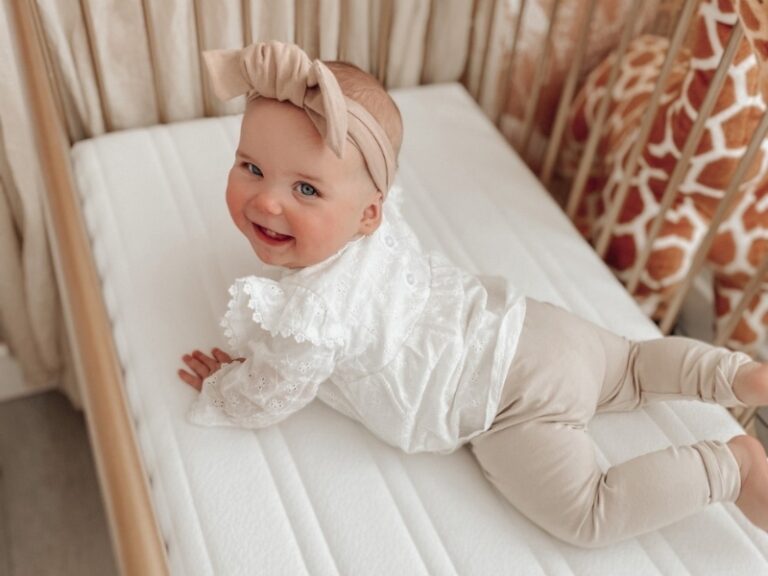
- Use a sleep wrap.
- Keep nighttime care easily accessible.
- Respect your baby's preferences



Order your sleep wrap directly online
Your baby needs a routine to sleep better. Additionally, it is important to respect your baby's preferences. Do you notice that your baby is very tired at 7 p.m.? Then try not to keep your baby awake until 10 p.m. This disrupts your baby's sleep rhythm and actually causes them to wake up more often during the night. Finally, we advise you to use a sleep wrap, which makes your baby feel safe and comfortable. A sense of security is important for good sleep. The sleep wrap immediately prevents your baby from rolling into a position in which you do not want them to sleep. Of course, you can order sleep wrap in our online store.Do you have any questions first, or would you like advice? Then feel free to contact us. contact join us.
Read more
Your baby isn't sleeping and you are worried about it. That is, of course, perfectly logical. As a parent, you assume that your baby is sleeping soundly, both at night and during the day. You know ...

Do you want to buy a side sleeping pillow to sleep better during your pregnancy and to experience more comfort while feeding your baby? Order your ideal pillow now! Buying a side sleeping pillow fo...